Q1: What are the main drawbacks of roll crushers?
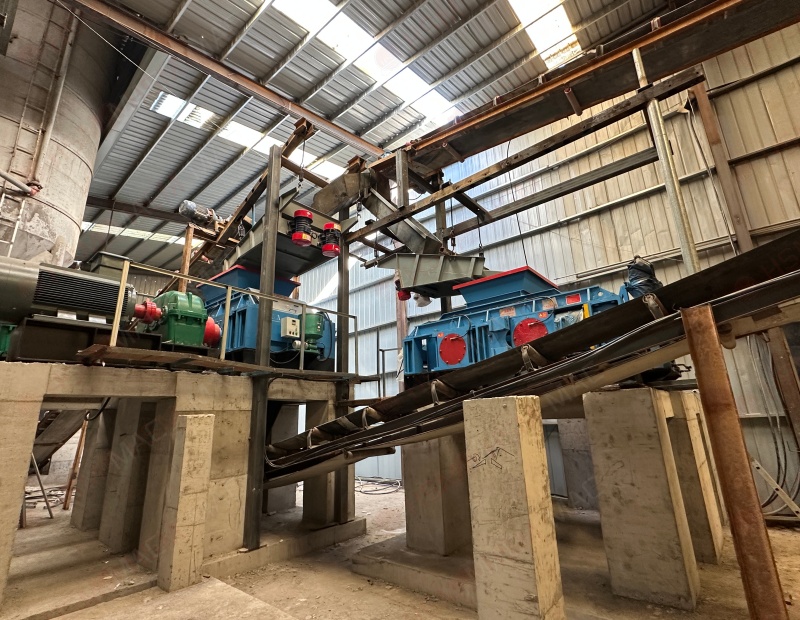
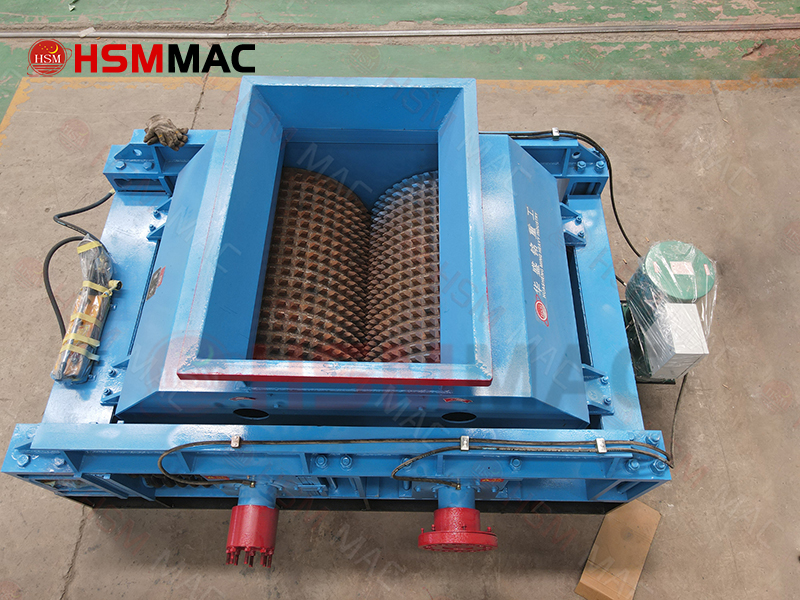
Double Roll Crusher Production Site
A: Roll crushers rely on double roller extrusion for fine crushing, delivering uniform granules and minimal over-grinding, yet they have inherent operational limits. Below are all limitations and matching solutions from field practice:
- Limited single-machine throughput
With the same overall dimension, hourly capacity is much lower than jaw, cone and impact crushers. It is not suitable for super-large mines with millions-ton annual output, only for medium & small fine crushing or pre-sand-making sections.
Solution: Run multiple roll crushers in parallel, or combine with high pressure grinding rolls for multi-stage crushing to meet higher output demands.
- Fast roller skin wear when processing extremely hard & abrasive ores
Ores above Mohs hardness 6 or with high quartz content wear roller skins rapidly, requiring frequent surfacing or replacement and raising maintenance costs. It is not recommended as primary fine crushing equipment for hard tantalum-niobium ore and quartzite.
Solution: Equip Huashengming high wear-resistant composite alloy roller skins, add primary crushing to reduce ore hardness before feeding; select high pressure grinding rolls for hard rare metal ores.
- Wet & sticky materials tend to stick and block rollers
Raw materials with high mud or moisture adhere to roller surfaces, causing unstable output size and unexpected shutdowns for cleaning.
Solution: Install anti-sticking scrapers on machines, add pre-screening and de-mud devices for feeding; choose toothed roll crushers for slightly damp materials.
- Strict requirement on even feeding
Irregular oversized lumps lead to uneven roller abrasion and inconsistent finished particle size.
Solution: Match constant-speed dosing feeders and pre-screen raw materials to remove oversize stones.
- Small reduction ratio, unable to finish coarse crushing to ultra-fine products in one step
A single roll crusher cannot handle huge feed lumps or produce powder finer than 3mm in one process, which makes it ideal only for secondary and tertiary fine crushing.
Solution: Install jaw crushers for primary crushing in front, and pair with ball mills afterward to realize more crushing less grinding.
- Fibrous long materials easily wrap around rollers
Straw, fibrous minerals and plastic mixed stones will wind around roller shafts and interrupt continuous production.
Solution: Add impurity removal equipment at feeding end; switch to shear-type crushers for such materials.
Q2: Roll crushers have many limits, why do most sand and mineral processing plants still pick Huashengming roll crushers?
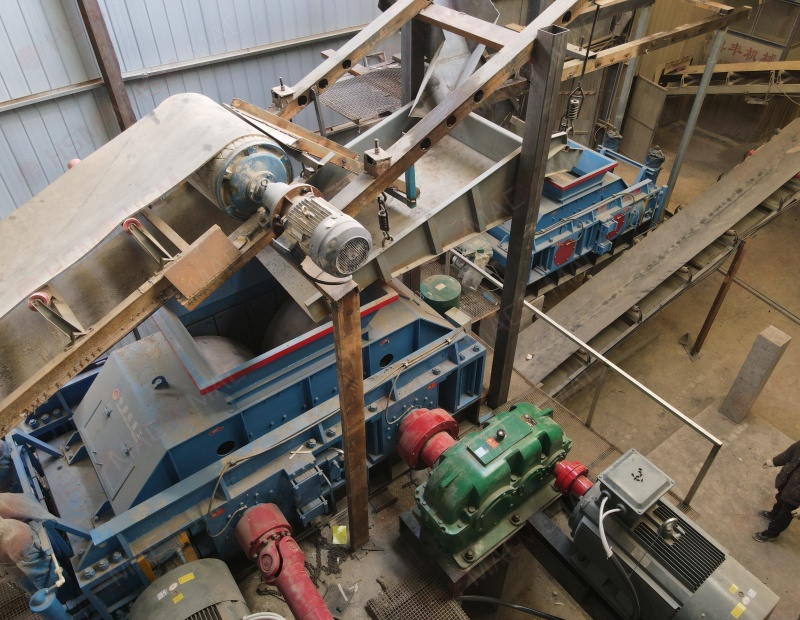
Double Roll Crusher Production Site Pictures
A: Every crushing machine has its applicable scope. Roll crushers show outstanding advantages for medium-hard ore, perlite, coal gangue, bluestone and weathered stone: extrusion crushing keeps fluffy material structure, low dust and well-shaped cubical particles with little waste fine powder. Huashengming optimizes structures to offset all drawbacks, including wear-resistant roller skins, anti-sticking components and spring safety buffer systems. All limitations can be fully avoided as long as you select machines matching your raw material and production capacity.
Q3: How to tell if roll crushers fit my raw materials?
A: Three simple rules for reference:
- Pick roll crushers if material Mohs hardness ≤5 without abundant hard quartz veins; choose high pressure grinding rolls for hard rare metal ores.
- Suitable for production lines below 200 tons per hour with strict demand on high-quality granules and low fine powder loss.
- Best performance with dry low-mud materials, or lines equipped with pre-screening de-mud facilities.
 +86-13838144666
 +86-13838144666